

GULDAGERGAARD ANAGAMA WORKSHOP
5 – 25 November 2027
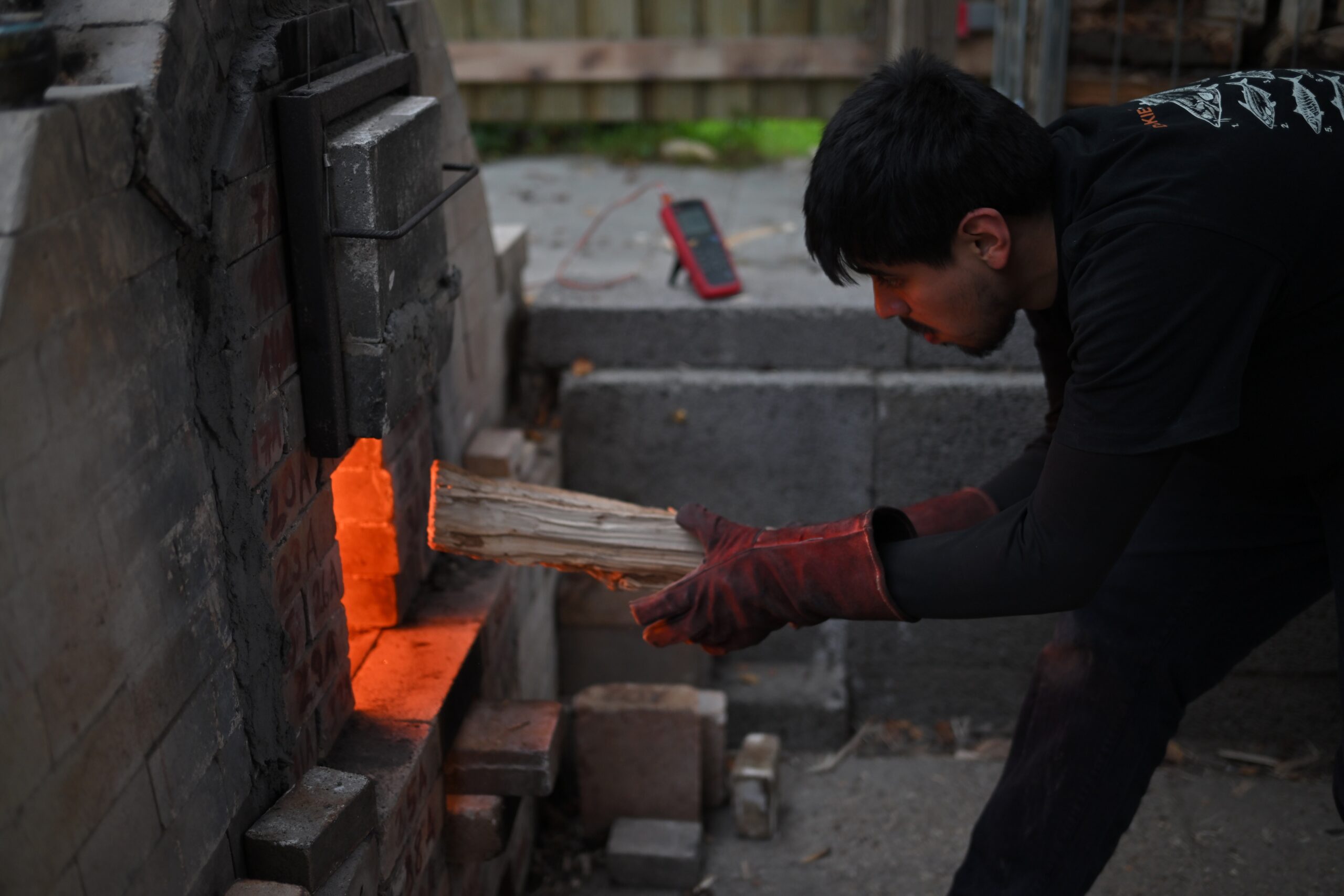
For our second Anagama workshop of 2027, we will once again fire the Babygama, a small anagama kiln built by Estonian kiln master Andres Allik. The kiln has a capacity of approximately 1.5 m³, with internal dimensions of W115 × L218 × H92 cm.
Anagama kilns are single-chambered and designed for long-duration wood firings. A distinctive feature of these kilns is the absence of a barrier separating the firebox from the main chamber, allowing full exposure of the ceramics to ash deposits, more so at the front and less towards the back. Guldagergård’s anagama includes a secret chamber at the back, known as the sutema, which helps stabilize firing conditions in the main chamber. The sutema can also be used for firing pots when a lower ash deposit is desired.
The workshop process includes: glazing, wadding, stacking the kiln, preparing firewood, and cleaning the kiln and the kiln furniture after firing. We will offer a range of glazes (shinos, celadons, tenmoku) and wood firing slips for you to try, but you are welcome to bring your own or make a glaze here at the center. (The provided glazes are included in the workshop price; however, you will need to pay for the dry materials if you choose to make your own glaze.)
The workshop runs for 11 days, and is led by our kiln yard manager, Oliver Harding
Important: teamwork and physical demands
The work before, during and after firing is labour-intensive and physically demanding. Firing the kiln is a collective effort that depends on everyone contributing. Good communication, cooperation and a willingness to support one another are essential to a smooth firing and to working through any challenges that arise.
What to expect from the firing
Wood-firing can produce unpredictable results. If you have little or no wood-firing experience, it is particularly important to approach the process with an open mind. Some results may differ from your expectations or may not appeal to you immediately. Sometimes, an appreciation for a particular piece develops over time.
Please also be aware that pieces can tip over during firing, depending on their construction, placement and wadding, as well as how the kiln is fired. A willingness to embrace these uncertainties is an important part of the workshop experience.
What you need to bring
1. All ceramics must be bisque fired and made from a cone 10 clay body. Stoneware with a high iron content is not recommended for this high-temperature glaze firing. However, work made from clay bodies such as Industrial Crank can be placed at the back of the kiln.
The front of the kiln needs medium and large pieces sturdy enough to withstand the intense conditions near the firebox. Small or delicate pieces are more vulnerable to cracking, warping or tipping over. We therefore recommend bringing work in a variety of sizes, if your practice allows.
Tall, narrow pieces are generally easier to accommodate, while flat, wide pieces may need to be left out if suitable space is unavailable. Individual pieces must not exceed L40 × W40 × H40 cm.
For a group of 10 participants, each participant should aim to bring approximately five banana boxes’ worth of work. If possible, bring some extra pieces, but please be aware that we cannot guarantee that all work will fit in the kiln.
2. Bring warm working clothes made entirely from natural fibres, such as cotton or wool. Synthetic clothing can melt when exposed to heat or flames and must not be worn during firing.
3. Bring a suitable particulate respirator for cleaning the kiln and kiln furniture after firing, and for handling dry materials if you plan to make your own glazes.
Workshop schedule:
Day 1 (10am – 6pm)
The group meets at 10am. There will be a short presentation of the kiln, the glazes, the glazing and wadding process, the firing process, and the overall organization of the firing. Afterwards, the group can start glazing their work.
Day 2 (9am – 6pm)
Glazing and wadding. Preparing firewood. Possibly start loading.
Day 3 (9am – 6pm)
Loading the kiln. Preparing firewood.
Day 4 (9am – 6pm)
Loading the kiln. Preparing firewood.
Day 5 & 6 & 7
Firing the kiln.
Day 8 & 9 & 10
The kiln cools down. No activities during these days.
Day 11
Unloading and cleaning the kiln. (It might take the whole day for unloading and cleaning, so if you plan to leave on this day, please do so after 5 or 6 pm.)
Language:
English
Price: 6800 DKK
The price includes: guidance, firewood, range of glazes and slips to choose from, wadding, working gloves and protective goggles, fire gloves, fire goggles, leather aprons and visors.
Meals and drinks:
Guldagergaard provides lunch every day during the workshop. Participants are responsible for their own breakfast and dinner and are welcome to use the communal kitchen in the manor house. Coffee is also available in the communal kitchen throughout the workshop.
Accommodation during the Workshop:
Unfortunately, it is not possible to stay at Guldagergaard. However, we refer you to Hotel Postgården (www.hotelpostgaarden.dk/en/) or Kaptajnhuset (bedandbreakfastguide.dk/dk/sjaelland/4230-skaelskoer/kaptajnhuset/s-412)
For any questions regarding bookings, please send an e-mail to: oskar@ceramic.dk. For any questions related to the kiln and the firing, please send an e-email to: oliver@ceramic.dk
Cancellation Policy
If you cancel earlier than 2 weeks before the workshop start date, unfortunately no refund will be provided.
If you cancel later than 2 weeks before the workshop start date, 50% of the total workshop fee will be refunded.
Cancellations must be made in writing to oskar@ceramic.dk
This policy is in place to ensure stable participant numbers and full workshops. As planning, materials, preparation, and reservation of places are arranged well in advance of the workshop, late changes can have a significant impact on both costs and organisation